One sentence in a courts ruling, takes away the settlement of a family in the loss of a Garrison man. "Decision of Court of Appeals Vacated; District Court Judgment Reversed and Case Remanded."
In summation, the document reads, "Michael Griffith died on the job after falling through an open catwalk gate into machinery owned by his employer, Wendling Quarries. A post-accident inspection revealed that the pins required to secure the gate in a closed position were missing." As a result, "Michael’s wife, Brea, and his father, Brian, sued three of Michael’s co-employees, alleging that they were grossly negligent and, therefore, liable under Iowa Code section 85.20(2) (2020). The case proceeded to trial, and the jury awarded $2.84 million. The defendants appealed the resulting judgment and the rulings denying their posttrial motions. The court of appeals affirmed the judgment, and we granted the defendants’ application for further review. On our review, we conclude that the co-employee gross negligence claims fail as a matter of law due to lack of evidence that these defendants had the requisite actual knowledge of the specific peril that caused Griffith’s death—the missing pins to secure the gate. Accordingly, we vacate the decision of the court of appeals, reverse the judgment of the district court, and remand for dismissal of the action."
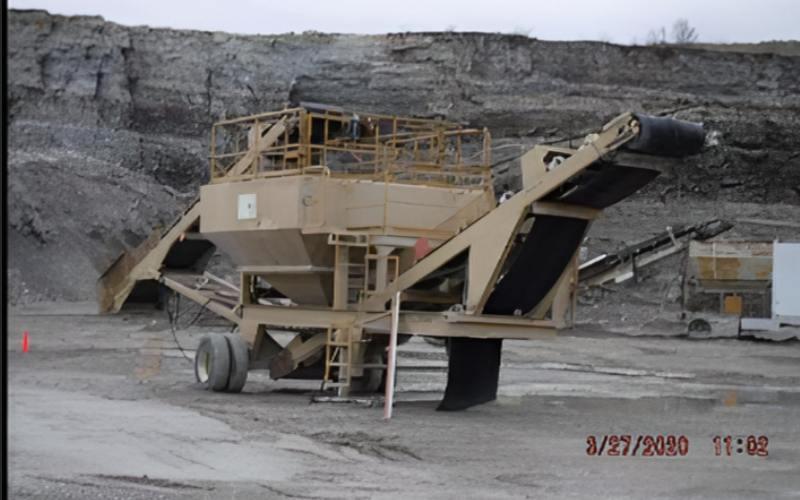
The court spells out the case. "Wendling operates thirty-three quarries throughout Iowa and the Midwest. One of its quarries—located in the city of Garrison in Benton County, Iowa— processes limestone into lime. After the miners excavate the limestone, it passes through a series of crushers and conveyor belts before it is deposited into lime surge hoppers." Pictured
"Because Wendling’s mining operations comprise numerous locations, much of its equipment is portable; lime surge hoppers are no exception. To move a hopper from one site to another, workers disassemble the bin, transport it to the new site, and then reassemble it, ensuring that all of the safety features are in place and operational. Lime surge hoppers collect processed lime, holding it until dump trucks carry it away. But, because the lime particulate is so fine, it periodically accumulates around the rim of the hopper, preventing consistent flow onto the conveyor belt. To alleviate this problem, many hoppers are equipped with a vibratory motor that sends tremors through the bin, causing impacted lime to break free and flow onto the conveyor belt. Without such a mechanism, someone must periodically scrape the sides of the hopper, pushing the accreted lime into the funnel and onto the conveyor belt."
"...one hopper did not have a vibratory motor; therefore, it required periodic scraping. To scrape the hopper, an employee would climb atop the machinery and stand on a catwalk that ran the perimeter of the bin. The catwalk was surrounded by a forty-two-inch-high metal railing. The railing itself had a gate, which could be opened for access to the hopper. The gate’s design allowed it to be secured by metal linchpins. Once an employee was on the catwalk, the employee could lean over the railing and—using a long metal pole provided for the purpose—scrape accreted lime from the sides of the bin onto the conveyor belt below. The inside of the lime surge hopper, because of its rapidly moving conveyor belts, the high volume of lime pouring into it, and the depth of the drop into its interior, is extremely dangerous. So, the person assembling the hopper must ensure that relevant safety mechanisms are in place, including appropriate retaining pins to secure the gate."
]"The United States Mining Safety and Health Administration (MSHA) oversees surface mines. Once or twice a year, MSHA inspectors visited the quarry and viewed the lime surge hopper in operation. At no point during those inspections did that agency raise concerns about the configuration or operation of the hopper. At Wendling, the responsibility both for assembling the lime surge hopper and for scraping the bin fell to the stockpilers. Stockpilers drive dump trucks onto quarry sites, collect processed lime, and transport it to a stockpile."
At the time of the accident, Griffith worked with two employees who were more experienced stockpilers at the Garrison quarry. Griffith was a novice stockpiler."
"On December 30, he began working as a stockpiler at the Garrison quarry. During his first week at the Garrison quarry, Griffith’s training spanned three days. On the first day, he rode along with an experienced stockpiler, who showed him the ins and outs of the job. On the second day, he drove a dump truck while an experienced stockpiler rode along. On the third and final day of his training, Griffith drove the truck on his own while an experienced stockpiler checked on him periodically."
The two employees that worked with Griffith, were responsible for moving and reassembling the lime surge hopper. They testified that it was their job to ensure that the catwalk, railing, and gates were in the correct positions. They testified that they had assembled the hoppers in one testimony five to ten time and the other said eight to ten times over the years before the accident.
Griffith’s supervisor had started with Wendling in 1997 and had worked as a stockpiler and scraped the hoppers many times. The supervisor had been a crushing superintendent at the quarry since 2009 and his duties included conducting weekly safety meetings and ensuring compliance with MSHA safety regulations. "He knew that no one had been injured on the hopper during the twenty-three years he worked there. No one had raised any safety concerns about the hopper during the weekly safety meetings. MSHA had never cited the quarry for any regulatory violations related to the hopper."
On the morning of January 8, the supervisors “just briefly” visually inspected the newly repositioned hopper from ten to fifteen feet away by the glow of his headlights. He did not get out of his truck to climb onto the hopper to check the gate or its linchpins. "That afternoon, another of the employees noticed that the bin of one of the lime surge hoppers was overflowing and that its conveyor belt was smoking. He summoned help, and he and a coworker tried to get the hopper running again. Their efforts unavailing, they climbed onto the bin where they saw that Griffith had fallen into the hopper. Wilson noted at that time that the catwalk gate was in the lowered or open position."
Griffith was unable to revived. The medical examiner ruled that Griffith died of asphyxiation, apparently having fallen through the catwalk gate into the bin, where the lime buried him.
Wendling’s President, nor Wendling’s safety and environmental director were present on the scene. Another worker labeled it a "freak accident" and another stated that they didn't think this type of accident was possible.
"MSHA investigated the accident and cited Wendling for multiple rule violations related to Griffith’s death. It came to light that, on the day of the accident, the catwalk gate was secured not with the standard retaining pins but with a strip of metal wire, meaning that it was less secure than it could have been." When transporting the machine, wire was used to secure the gate while relocating to the new site. The co-worker said that he'd never seen the gate secured with after the machine was delivered and would have prevented anyone from climbing onto the machine had he known that the retaining pin was missing.
No one could explain how the wire wound up on the gate in place of the pins.
In July, the family sued the co-workers for "gross negligence."
The plaintiffs’ motions for civil actions were consolidated by the District Court. The case proceeded to an eight-day jury trial in April 2023. During his testimony,the co-workers stated that "the inside of the lime surge hopper was “insanely” dangerous," and “working around that open hopper was inherently dangerous." "The plaintiffs produced evidence that: (1) the catwalk gate had been improperly secured; (2) there were remedial and preventative measures that could have saved Griffith’s life, including, among other things, the installation of a vibratory motor, the use of netting, the implementation of a lock out/tag out system, a requirement that employees wear safety harnesses with lanyards while working above the hoppers, or the installation of kill switches that would shut off the hoppers in case of an accident; and (3) quarry supervisors had performed minimal inspections of the machinery before beginning work."
At the close of evidence, the district court granted the defendants’ motion for a directed verdict for one of the defendants, but denied similar motions pertaining to the two others.
"At the jury instruction conference, a dispute arose over the proper gross negligence marshaling instruction...The defendants objected to the instruction, arguing that it incorrectly stated the law because the uniform instruction focused on mere knowledge."
"The jury returned a verdict awarding about $2.6 million to Brea, Griffith’s estate, and L.M.G., and $200,000 for Brian. The district court denied the defendants’ motions for judgment notwithstanding the verdict (JNOV) or new trial."
"The defendants appealed, arguing that the district court erred in four ways:
(1) by denying the defendants’ JNOV motion despite the fact that Kulper and Galloway lacked “actual knowledge” of the peril,
(2) by giving an improper jury instruction on gross negligence,
(3) by admitting evidence of the MSHA citations issued to Wendling, and
(4) by allowing a physician’s assistant and a therapist, both of whom were treating Brea, to testify as undisclosed expert witnesses."
The court summed it up by saying, "For want of linchpins, a life was lost. By all accounts, Griffith fell to his death through an open, unsecured gate. The missing pins would have secured the gate in a closed position. A proper inspection presumably would have discovered that the pins were missing and that the gate was inadequately secured. Griffith’s fatal accident was preventable. But the plaintiffs must clear a high bar to recover against Griffith’s co-employees for his on-the-job accident. More than proof of ordinary negligence is required.
To recover tort damages beyond the workers’ compensation system’s death benefits, the plaintiffs had to prove Galloway or Kulper actually knew that the pins were missing and that the gate was unsecured. Constructive knowledge, meaning proof that they should have known of this peril, is not enough." (There is much more to this explanation beginning on page 12 where other lawsuits of the same kind are cited.)
" A jury could easily find that his cursory inspection was negligent, but without proof that Galloway actually knew of the missing pins, the gross negligence claim against him fails." (pg. 18)
The court concluded, "For the foregoing reasons, we vacate the decision of the court of appeals and reverse the district court judgment. We remand the case for entry of an order dismissing this civil action with prejudice. On this trial record, the death benefits provided under Iowa’s workers’ compensation statute are the plaintiffs’ exclusive remedy for Griffith’s fatal on-the-job accident. Decision of Court of Appeals Vacated; District Court Judgment Reversed and Case Remanded."
The full document of the ruling can be readPDF not working? Click the 3 dots and choose Download This File 🠟


Comments
Submit a CommentPlease refresh the page to leave Comment.
Still seeing this message? Press Ctrl + F5 to do a "Hard Refresh".