-
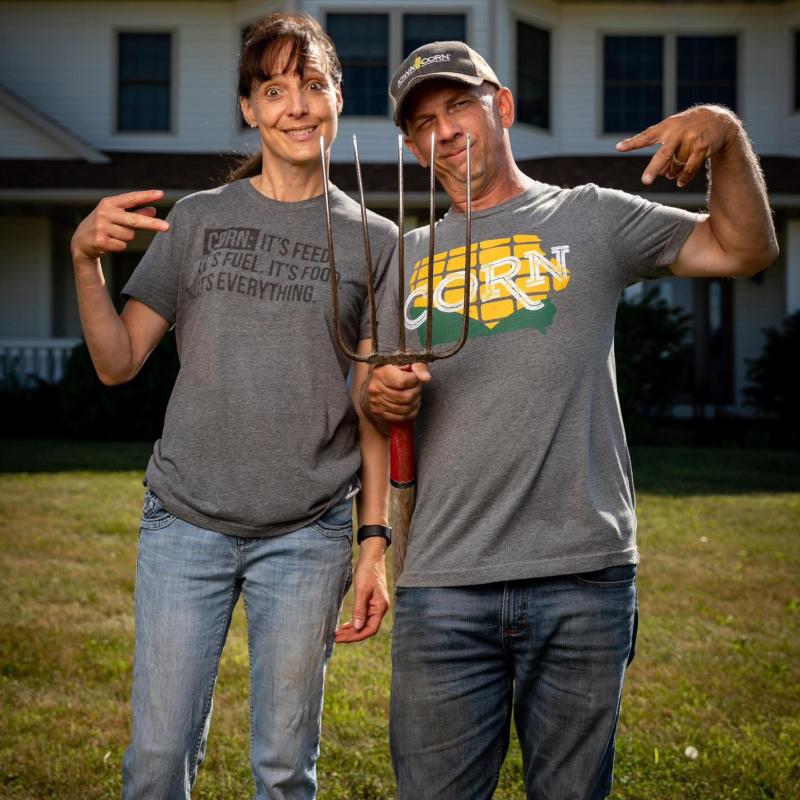
 Lance and Heidi Lillibridge, local Vinton farmers share what farming is really like.
 -

Lance Lillibridge, a Vinton farmer, stood at Columbia College in the heart of New York City in front of a room full of those with a PhD. He joked that he had a PhD too, only his stood for Piled High and Deep.
Farming his whole life has taken him to farms around the world, put him at the table with NASA, and this past week, he hosted a Japanese delegation on his farm. He's been featured in the media around the world, and social media has given him an online presence. His viral post, entitled "I'm a pissed off farmer," has connected him with people who agree or feel like he's just whining. Either way, it helped to open dialogue with those who don't understand farming.
There is still one person he really needs to talk to, but he hasn't had the opportunity to yet. He feels that if he could tell President Trump one thing, it would be, "Mr. President, there's a problem that is going to set this country on the course to failure."
Farming has been attacked relentlessly by those who don't understand it. Accused of wrecking the environment, farmers are often the farthest from doing that. At Columbia, he heard the NYC Food Czar share that she wanted to make their 1.3 million meals served a day, be plant-based protein, citing "the need to reduce the carbon footprint."
Lillibridge explained to the room. "I have red Angus cows with a pasture next to the river. I can't farm it it would be an environmental train wreck. Instead," he explained, "the cattle graze on the land and turn it into a nutrient-dense red meat protein. No fuel is consumed, burned or wasted. The soil isn't tilled. Show me just one vegetable-based protein that is in a no-til patch." He explained that all vegetables grown for this purpose require heavy tilling that destroys the soil structure and takes a tremendous amount of diesel fuel to produce. "I don't see where that is more environmentally friendly. End of story."
The entire group, applauded. That isn't what they had been led to believe. The organizers of the event told him "you have no idea how badly these people needed to hear this."
Let's look at the true cost of the steak you order in a restaurant. Beef
Suppose you order a 16 oz. ribeye/t-bone/etc. If it costs $36.50 and if you tip the waiter 15%, that's a $5.50 tip simply for taking your order and delivering the plate to your table.
In order to raise that cow, to provide that tasty meal, the farmer gets out of bed at 2:00 a.m. to check on the baby calves and mother to make sure they are alright after birth, they pay for seed, fertilizer, diesel, a tractor/parts/labor, if the calf busts out of the fence he chases them, keeps them clean, hauls away their manure, makes sure they have fresh water, if they get sick or injured he calls a veterinarian, he buys his land, pays property taxes, insurance...takes all the risks and on a good year, he makes $2.30.
What's Lillibridge's "beef" with the system? He believes that the problem starts at the top. In Washington D.C. trade associations like the Fertilizer Institute influence and create a narrative for the Agriculture Department and legislators without input from farmers. Farmers need a voice in the hearings that pertain to them and their industry.
How the Fertilizer Game Works
Do you remember the games, "Monopoly" or "Pit?" The idea of both games is to own all the "land" or "railroads" in the first and to "corner" the market in the latter, meaning you hold all the cards for the commodity (Corn, wheat, rye, in this our example, we're going to call one category, "fertilizer" to grow these foods).
The fertilizer companies consolidated, leaving only four to five companies who control the three fertilizer ingredients. One controls 90% of the potash, another 75% of the phosphorus and three or four control 100% of the Nitrogen.
Those companies bought all the "properties on the board" and "cornered" the fertilizer market. Farmers have no choice, there's no competition in the market. It's now a monopoly.
Let's compare January 2021 prices for the farmer vs. today's prices in 2026:
Anhydrous Ammonia - $490 a ton to $850
Phosphates - $400 to $890
Potash - $300 to $425-450
In January of 2021, a bushel of corn brought in $5.15 now it only brings in $4.48 (according to Macrotrends).
Countervailing Duties were applied by the International Trade Commission after a solicitation by the Mosaic Company to imported fertilizer from Morocco, Lillibridge said. These applied to phosphates arriving from other countries. creating a $6 billion expense to be shouldered by a mere 1% ofthe population, the farmers.
Lillibridge explained, "Over the last five years, margins for farmers have disappeared, there is no transparency for "why" the prices of fertilizers are going up other than claiming it's a 'global market.' There is an abundance in this country," he explains.
There's a monopoly on seed sales as well. Only three companies control this market. To say that farmers feel like the antitrust laws are not being enforced in this case would be an understatement. Those of us who remember the breakup of the "Ma Bell" phone company remember when it was broken up into several "baby bells," bringing competition. The same happened to Standard Oil.
Profit in the fertilizer companies range from a likely $300 to $500 profit per ton. A third company is private, so data is not available.
How do the wars in Ukraine and Iran affect prices?
In short it doesn't. Remember on 9/11 when everyone flocked to the gas station, and some of those stations raised the prices to profit? That's what's happening now. The supply is already here, so Iran has nothing to do with it Lillibridge said. "This has been an issue for more than a decade." He cited the 2012-13 prices which went out of control but self-corrected quickly. In 2026, there has been no correction.
On February 28, Lillibridge was in San Antonio, Texas and learned that we had gone to war with Iran. Fertilizer companies hid their prices, fuel prices went through the roof, yet the supply stateside hasn't changed.
Companies cite "replacement" costs. 30% of the world's supply goes through the Straight of Hormuz...not America's supply. However, because it is called a "Global Market," it can now be tied to the crisis, and prices skyrocketed.
It takes six weeks for anything possibly reaching here from the Straight of Hormuz.
The Media
"Agriculture will cease to exist the way it has. It's a culture and it's going to go away and people could find themselves in a desperate situation." Simply put, every food in the grocery store is provided by...a farmer. (Lillibridge interview, October 2025, KCRG, "I'm a pissed off farmer")
Lillibridge shared the clip above, as well as another interview that he was part of. These originated from one of the coasts. Scary music played in the background as the reporter read, "Spring is here, which means that it's planting season here in Iowa. For corn farmers preparing to sow their fields, the war with Iran couldn't have come at a worse time." The clip cuts to a different farmer who is asked, "So how much did it (fertilizer) go up after the war erupted:" the reporter asks. "The cost of two widely used fertilizers shot up by 20 and 50% in the first few weeks of the war," a farmer's wife reports.
"With the price of fertilizer already higher than last year, she put off buying until last month hoping the price would go down. Then the war started and the opposite happened. With the window to plant closing, she had little choice but to buy at a high price." The costs for the interviewed farmer explained that the cost had jumped $13,000 in two days and could lose $110 per acre across 530 acres = $58,000.
With close to 20 media interviews, Lillibridge makes it clear. "I don't blame the costs on the war on Iran. It amplified it. We had a problem before that. We had a problem as far back as before the first Trump administration and got out of control during the Biden administration. The corporations saw an opportunity to prey on the farmers and took it. We need protection against it.
"Capitalism:
An economic system based on private ownership of the means of production where supply, demand, and competition drive prices and economic growth"
Lillibridge said, "We don't have that in agriculture at the farm level."
How do we fix it? Lillibridge said he doesn't know. "But I know if we don't fix it, our sons and daughters won't want to do this job. Whose going to do it? Other countries? Then we will be importing all of our food. That shouldn't be happening. Consolidation is the problem, and if they are broken up...they aren't going to like it. But it has to happen.
'This isn't about surviving as a farmer, it's about the survival of a nation.'
-Lance Lillibridge
Comments
Submit a CommentPlease refresh the page to leave Comment.
Still seeing this message? Press Ctrl + F5 to do a "Hard Refresh".
True ignorance cannot be underestimated.