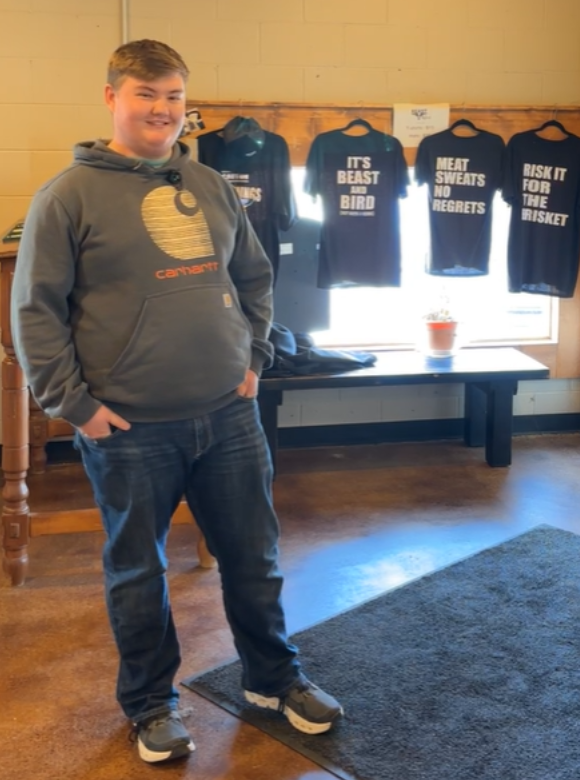
Will McKenna, son of Nichole and John, shared a speech he gave as part of a FFA Public Speaking project. As required, it addressed several agricultural topics entitled, "Making Room for the Next Generation." He addressed the challenges faced by farmers and those who want to step into the community. (His speech in full, is at the end of this article.)
McKenna has taken his speech to the Sub-Districts in Waterloo, where he recieved a Gold, which advanced him to the District competition where he placed 2nd. Next he will compete at the State level. He also competed at the WaMaC event as part of the Speech team. Competing in Original Oratory, he brought home Division 1, sending him to the State competition where he received another Division 1. He was then nominated for All-State.
After he shared his speech with the local Vinton Kiwanis, he took questions surrounding the topics in his speech. He was asked to share why he chose the topic that he did. He said, "This topic is really personal for me, given my past experiences with suicide and mental health in the agricultural industry." He shared all of the things that drove him to write what he did. The loss of a close family friend at a young age in the industry, learning more about what was happening in the industry, the struggles faced and his own families involvment, and trying to find ways for the next generation to transition into farming. "Having our own ideas, and passing it on has been what has really inspired me to talk about this topic."
He was asked about all of the research that went into his speech. He started last summer working until after the new year. Then he began memorizing it and sharing with other groups to get their feedback.
Someone asked him what excites him the most about being the next generation to step into farming. Will said, "The opportunity, for sure. There's so much more coming with technology, AI...that's the most exciting for me."
For just a second, he paused when asked, "What would be your plan to pass it on to the next generation?" As Will is still in high school, that might not be something he'd thought too much about. But he pointed back to his own experience and how his parents have supported him and allowed those conversations to happen.
He said the most interesting thing that he learned was the various practices and the struggles within the farming communities. He said that he was surprised by all of the background issues and the resources that are out there to help both the young and older farmers. Addressing the farming crisis of the 80s and the struggles that farmers are seeing how, he was asked what similarities he's seeing. He pointed to the costs, citing the costs of fertilizer and how it affects the income.
Below is his speech in full, complete with all of the footnotes for his research. Well done, Will!
More Than a Legacy: Making Room for the Next Generation
MORE THAN A LEGACY: MAKING ROOM FOR THE NEXT GENERATION
Tradition is the backbone of agriculture. Generations have walked the same fields, fed the same livestock, and passed down the same methods with pride. Yet, what happens when tradition becomes a barrier instead of a bridge? What happens when the very wisdom that built the agricultural legacy begins to control or silence the voices of those ready to carry it forward?
This is the unfortunate reality for too many young agriculturalists today, who enter this industry wide-eyed, passionate, and ready to embrace the future of agriculture. Instead of being seen as the next generation of leaders, younger agriculturalists are viewed as threats to the traditional ways of life. This shift happens somewhere between walking into their first meeting with other farmers, ranchers and producers alike, and walking out of the barn at midnight. We realize something, change isn't just hard, it often seems unwelcome. Phrases like "toughen up" or "get over it" take the place of encouragement. In 2024 the National Young Farmers Coalition reported that many young people leave agriculture not because they lack skill or passion, but because they lack a voice and meaningful mentorship (Manly). The pressure of balancing decisions to advance operations while respecting the past isn't just frustrating, it's dangerous.
A 2023 study done by the University of Illinois Urbana-Champaign shares that farmers and their families are experiencing alarmingly high levels of mental strain. Researchers found that nearly 60 percent of farm adults and adolescents met criteria for at least mild depression, and almost half showed signs of anxiety disorders (Stine). Stress in the industry isn't isolated, it's shared across generations, households, and entire operations.
The discussion of mental health in agriculture is a well-documented crisis. The American Farm Bureau Federation reports that stress and mental health are now among the top concerns facing farm families nationwide (Tomko, 2025). It doesn't stop there. The CDC further reported that agriculture consistently ranks among the highest-risk industries for suicide in the United States (Sussell, 2023). Add isolation, financial pressure, and generational conflict and the risk only increases.
Mental stress is only magnified when young farmers feel stuck between two worlds: one foot planted firmly in the soil of tradition, the other trying to move forward with innovative practices that could protect the land, save labor, and sustain the industry long-term. The USDA reported that the average American farmer is nearly 60 years old, therefore the future of agriculture quite literally depends on whether younger generations feel welcomed enough to stay (Halvorson, 2022). Trouble is, instead of being embraced they're often dismissed, called lazy for using precision agriculture, soft for valuing work-life balance, and judged for advocating mental health, sustainability, and inclusivity alongside soil science. This tension isn't just emotional, it's structural. A recent article from DTN Progressive Farmer explains that one of the biggest threats to farm longevity today isn't weather or markets, its failed generational transitions (Woodbury, 2025). When younger producers are shut out of decision-making and older generations refuse to let go of control, farms don't just stall, they fracture.
Younger producers often encounter resistance in the form of "that's not how it's been done before," yet these long-standing norms have played a role in rising stress levels, generational burnout, and the loss of young leaders who leave agriculture for more secure "town jobs" offering better compensation and benefits. Organizations like Farm Aid warn that when emotional well-being is ignored, young producers don't just leave farms, they leave the agriculture industry entirely (Pressman, 2021), raising serious concerns about the industry's long-term viability.
The work and resilience of older farmers, ranchers, and producers is honorable, but a future worth inheriting will require encouragement and support instead of criticism. Recent research from FarmProgress emphasizes that farm succession isn't just about ownership, it's about identity, communication, and trust (Splear, 2025). When those conversations don't happen, the focus shifts from maintaining legacy to simply having a future plan. An article from UnCommon Farms in late 2025 highlights that many successful farms today survive only by adapting leadership models, sometimes transitioning operations to younger employees when family communication breaks down (Haferkamp). Tradition alone is no longer enough to ensure successful succession.
Let me tell you about a friend, we'll call him Caleb. He's 25 and wakes up before 5 a.m. every day, works long hours in the barn, and dreams of taking over his family's swine and row-crop operation. Recently, Caleb told me that sometimes, he doesn't even want to go home, not because he doesn't love his family, but because no matter what he says, no one listens. He talks about autonomy in the barn, they laugh. He brings up mental struggles, they roll their eyes. He's trying to pave his own path, but still feels like a failure. Caleb's story isn't rare. According to Michigan State University Extension, unresolved stress during farm succession is one of the leading contributors to emotional burnout in young producers (Oebel, 2025). When communication breaks down at home, even the most committed young producers like Caleb can feel trapped between love for their family and the pressure of unmet expectations.
Perhaps the most painful contradiction in agriculture is this: the industry often claims it needs young people to step up, yet when they do, they are frequently asked to step aside. Addressing this challenge begins with normalizing honest conversations, not only about suicide or depression, but about how resistance to progress contributes to both. The solution also calls for building bridges between generations rather than battlegrounds, creating mentorships grounded in listening instead of lecturing. Finally, it means valuing the voices of younger producers by extending the same respect in discussions about cover crops, innovation, and career paths that is given to the land and traditions that shaped previous generations. An interview with Farm Credit Mid-America, states that because farming is so closely tied to identity, generational transitions can be emotional, and that successful family transitions require older generations to step back while still supporting the next generation's success (Tucker, 2025). The future of agriculture depends on more than just passing down land; it depends on supporting young farmers as they step into leadership while still respecting tradition and new ideas.
Emerging producers are not asking for a free ride nor praise. We're asking for an opportunity, trust, and for the ability to be human in an industry that too often demands people to be carbon copies of those who came before them. The fields may look the same and barns familiar, but agriculture is constantly changing. To keep up, perspectives need to change too. It's not either/or, the future requires both/and. The future of agriculture doesn't begin when one generation steps aside. It begins the moment we stand together.
References
Haferkamp, J. (2025, December 3). Non-Family farm succession: Preserving your farm legacy with key employees. UnCommonFarms_2022_No_tag_HORIZONTAL. https://uncommonfarms.com/blog/non-family-farm-succession-preserving-your-farm-legacy-with-key-employees
Halvorson, J. (n.d.). 2022 census of agriculture impacts the next generations of farmers. USDA. https://www.usda.gov/about-usda/news/blog/2022-census-agriculture-impacts-next-generations-farmers
Manly, J. (n.d.). New Census of Agriculture reveals more young and beginning farmers, but less farmland and fewer small farms.National Young Farmers Coalition. https://youngfarmers.org/2024/02/new-census-of-agriculture
Misty Oebel, M. S. U. E. (2025, March 21). Strategic succession. Managing Farm Stress. https://www.canr.msu.edu/news/strategic-succession
Pressman, A. (2021, November). Farm stress and emotional well-being, part I. Farm Aid. https://www.farmaid.org/wp-content/uploads/2021/12/FRN_guide-farm_stress_and_emotional_well-being_vol12.pdf
Splear, A. (2025, October 16). Farm succession planning: Understand both sides. Farm Progress. https://www.farmprogress.com/farm-business-planning/understanding-both-sides-keys-to-successful-farm-succession-planning-conversations
Stein, M. (2023, June 12). Farm stressors affect mental health of adults and adolescent children. Illinois. https://aces.illinois.edu/news/farm-stressors-affect-mental-health-adults-and-adolescent-children
Sussell, A. (2023, December 14). Suicide rates by industry and occupation - National Vital Statistics System, United States, 2021. Centers for Disease Control and Prevention. https://www.cdc.gov/mmwr/volumes/72/wr/mm7250a2.htm Tomko, M. (2025, November 4).
Farm Bureau welcomes next era of supporting Farmer Mental Wellbeing. American Farm Bureau Federation. https://www.fb.org/news-release/farm-bureau-welcomes-next-era-of-supporting-farmer-mental-wellbeing
Tucker, W. (2025, September 29). The Five Phases of Farm Succession Planning. Farm Credit Mid-America. https://www.fcma.com/community/insights/the-five-phases-of-farm-succession-planning
Woodbury, L. (2025, December 1). Supporting generational transitions. DTN Progressive Farmer. https://www.dtnpf.com/agriculture/web/ag/news/article/2025/12/01/supporting-generational-transitions
Comments
Submit a CommentPlease refresh the page to leave Comment.
Still seeing this message? Press Ctrl + F5 to do a "Hard Refresh".