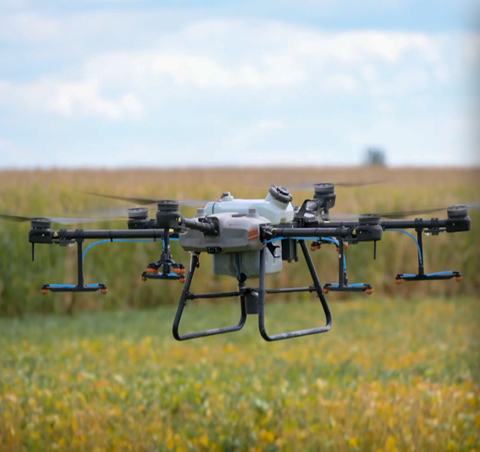
Drones are beginning to play a role in Iowa agriculture, particularly for crop monitoring and pesticide application, but most farmers remain uncertain about the technology ¢â‚¬â„¢s advantages and limitations, according to results from the 2025 Iowa Farm and Rural Life Poll, an annual survey of Iowa farmers conducted by Iowa State University Extension and Outreach.
Aircraft have been used in farming for decades for tasks such as scouting, spraying and planting cover crops. Recent technological advances in unmanned aerial vehicles, commonly known as drones, have expanded their potential use in farm operations. As drones have become more affordable and easier to access, interest among farmers has grown. The 2025 farm poll included several questions designed to better understand how farmers are using drones and how they perceive the technology.
¢â‚¬Å“As agricultural drone technology has improved, many opportunities to more efficiently scout for and treat pests and disease have emerged, and both farmers and drone service providers are taking advantage, ¢â‚¬ � said J. Arbuckle, extension sociologist and director of the Iowa Farm and Rural Life Poll. ¢â‚¬Å“This year ¢â‚¬â„¢s survey looked at how farmers are using drones and their attitudes toward them, to better understand their information needs. ¢â‚¬ �
Extent and type of drone use
Overall, 22% of surveyed farmers reported using a drone or a drone service provider in 2024. Among those who used drones, access most commonly came through specialized drone service providers (51%), followed by hiring an agricultural retailer or cooperative (37%). About one-quarter of drone users reported owning their own drone, while a smaller share rented or borrowed equipment.
The most common use of drones was monitoring and scouting crops, reported by 62% of drone users. Pesticide application was nearly as common, with 56% indicating this use. Fewer farmers reported using drones for planting (20%) or fertilizer application (9%).
Patterns of use differed depending on how farmers accessed drones. Farmers who owned or rented drones primarily used them for monitoring and scouting crops, with relatively limited use for spraying, planting or fertilizing. In contrast, farmers who hired drone services ¢â‚¬â€� either through cooperatives, agricultural retailers or specialized providers ¢â‚¬â€� most often used drones for pesticide application. Among these farmers, drone services accounted for a substantial share of their pesticide application work.
¢â‚¬Å“Farmers don ¢â‚¬â„¢t need to invest in drones right away, ¢â‚¬ � said Doug Houser, digital agriculture extension specialist, ¢â‚¬Å“Many are gaining experience by working with drone service providers, which allows them to better understand the value of the technology on their operation before making a purchase decision. ¢â‚¬ �
Farmer attitudes toward drones
The survey also asked all respondents, regardless of use, about their attitudes toward drones. Agreement with both positive and negative statements was generally modest. The only positive statement that received majority agreement was that drones ¢â‚¬Å“can be controlled with precision, ¢â‚¬ � which 61% of farmers agreed with. Fewer than half agreed that drones save time and effort, spray uniformly or increase labor efficiency, and only 25% agreed that drones are generally easy to operate.
Among potential concerns, the most widely shared was that drones are difficult to operate in windy conditions, with 58% of respondents agreeing. Other concerns ¢â‚¬â€� including malfunction risks, pesticide drift, maintenance costs, battery life and transportation challenges ¢â‚¬â€� were endorsed by fewer than one ¢â‚¬â€˜third of farmers.
A notable finding was the high level of uncertainty. For eight of the 12 attitude statements, a majority of farmers selected the ¢â‚¬Å“uncertain ¢â‚¬ � response. This likely reflects limited direct experience with drones, as fewer than one in four farmers reported using them in the previous year.
¢â‚¬Å“Interestingly, uncertainty was high on most attitudinal items for both drone users and those who have not used them, ¢â‚¬ � noted Arbuckle. ¢â‚¬Å“A big take-home is that while many farmers are interested in the technology, they ¢â‚¬â„¢re still not comfortable with drones and have a lot to learn. ¢â‚¬ �
Implications for outreach and education
Taken together, the results suggest that while drone use is expanding ¢â‚¬â€� particularly through custom service providers ¢â‚¬â€� many Iowa farmers need more information to help them evaluate the technology.
¢â‚¬Å“We are still early in the adoption curve, but drones are getting better at range of applications from crop scouting and rock identification to developing spray prescriptions, and farmers are wanting to know more about them, ¢â‚¬ � added Houser. ¢â‚¬Å“ISU Extension and Outreach has been developing informational resources and workshops to provide farmers with opportunities to learn about drones and whether they might make sense for their operations. ¢â‚¬ �
About the Iowa Farm and Rural Life Poll
Conducted annually since 1982, the Iowa Farm and Rural Life Poll gathers insights from farmers statewide to inform research, extension programs and policy decisions. This report and previous reports are available through Iowa State University Extension and Outreach.
Comments
Submit a CommentPlease refresh the page to leave Comment.
Still seeing this message? Press Ctrl + F5 to do a "Hard Refresh".